
AD DS Users, OUs, & Groups
Users and OUs
Organisational Units - a means of separating users and devices/objects based on location, site, role, job, department
- A user account can only be a part of one OU (unlike groups)
- OUs can be used to handle Group Policy objects - will filter down to OUs below the specified OU
- Helps to visually separate objects
Example 1
- Sydney OU
- Users
- Computers
- Brisbane OU
- Users
- Computers
Example 2
- Sales OU
- Users
- Computers
- Finance OU
- Users
- Computers
Groups
- Dsitribution Groups (DLs) for Email
- Security Groups (Permissions) and Email
Group Scopes
- Global
- Domain Local
- Universal
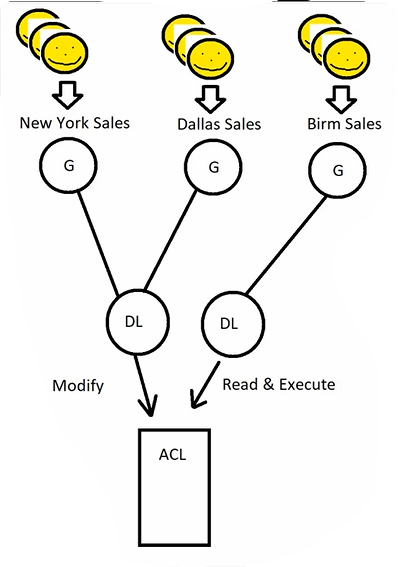
Microsoft Strategy
- Accounts
- Global
- Domain Local
- Permissions
- Domain Local
- Global
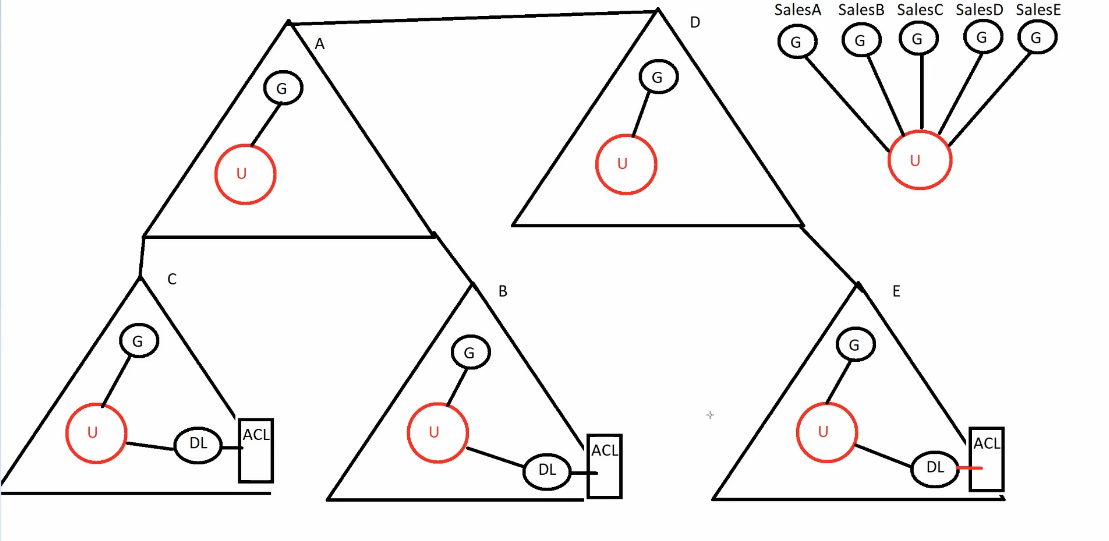
Universal Groups
*For larger organisations multiple globval groups can be linked to a single universal group, which is replicated across all domains
Universal Group Membership Caching Feature
- Global Catalog Servers contain a Universal Group List
- User Authentication occurs on D.C.s via Kerberos
- Kerberos needs to validate with the GCS to identify which groups this user is a member of (via the universal group list)
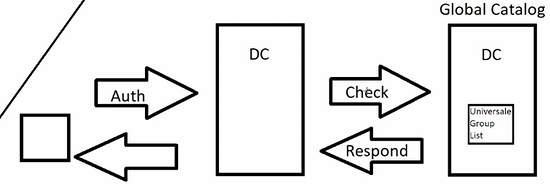
Scenario: users are finding it take a long time to log in - the global catalog server might be located in a different site to where the user and the domain controller are located
Solutions
- Make the D.C. a Global Catalog server (adds processing overhead)
- Universal Group Membership Caching
- Every 8 hours (default) domain controller will cache the Universal Group List locally