Domains, Trees, Forests
Domains, Trees & Forests
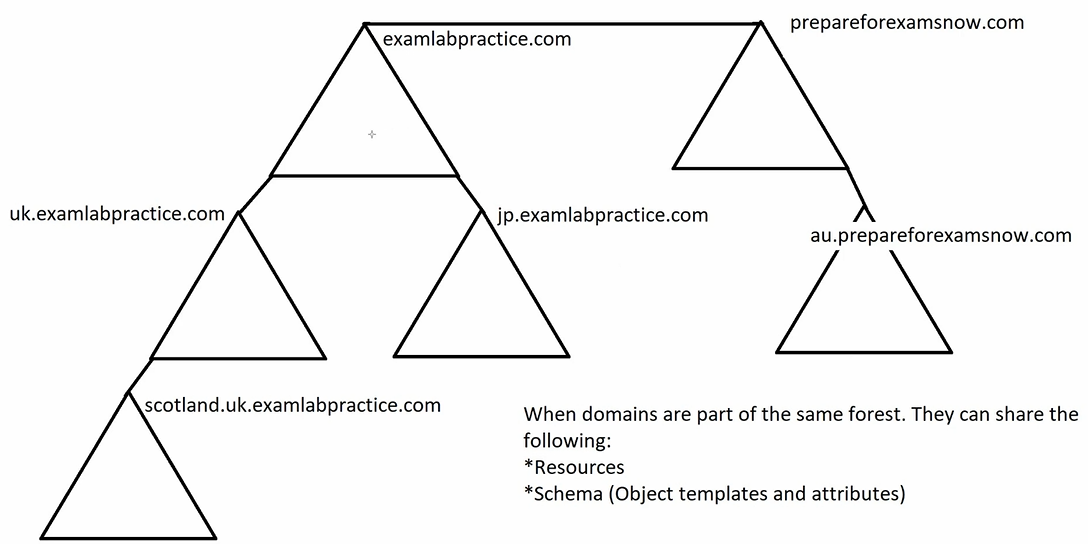
- Every Domain is part of a Tree, is part of a Forest (even a single domain)
- Domains which share the parent domain name belong to the same tree
- Trust Relationships connect domains
- Forest Root (Root Domain) - First domain, cannot change
- Enterprise admins control entire forest
- Domain admins control their domain
- Trees later merged via forest trust will share resources but not schema
- Global catalogue is replicated across the whole forest
Trusts
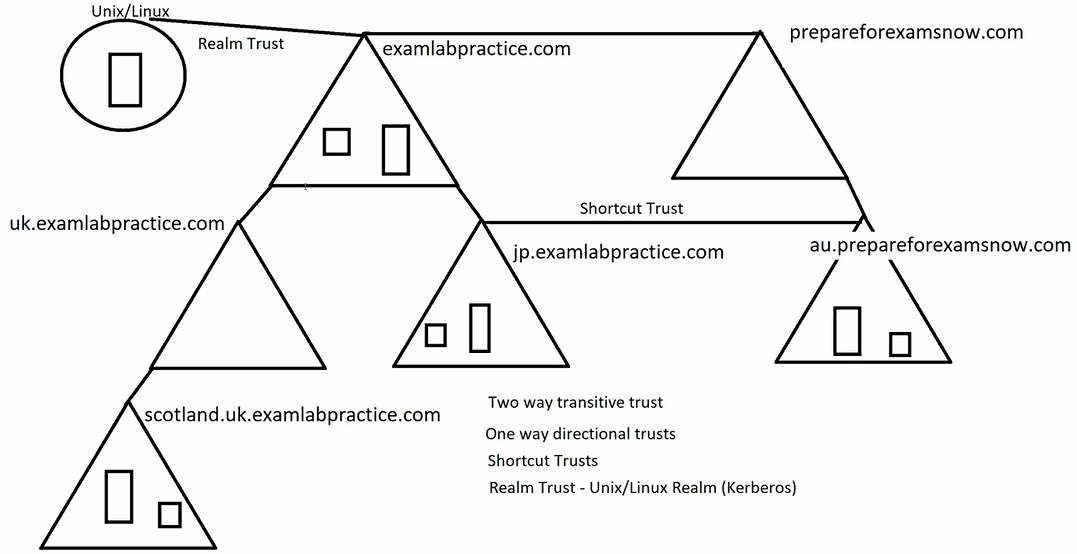
- Trust Relationships can have a
- Two-way transitive trust (follows through to sub-domains)
- One-way directional trust
- Shortcut trust (can be either of the above) (two or one way)
- Forest trust - between two forests (unlike below) (two or one way)
- Realm trust - Unix/Linux Realm (Kerberos)
Setup via Active Directory Domains and Trusts
Configure DNS to ensure they can communicate (conditional forwarders)
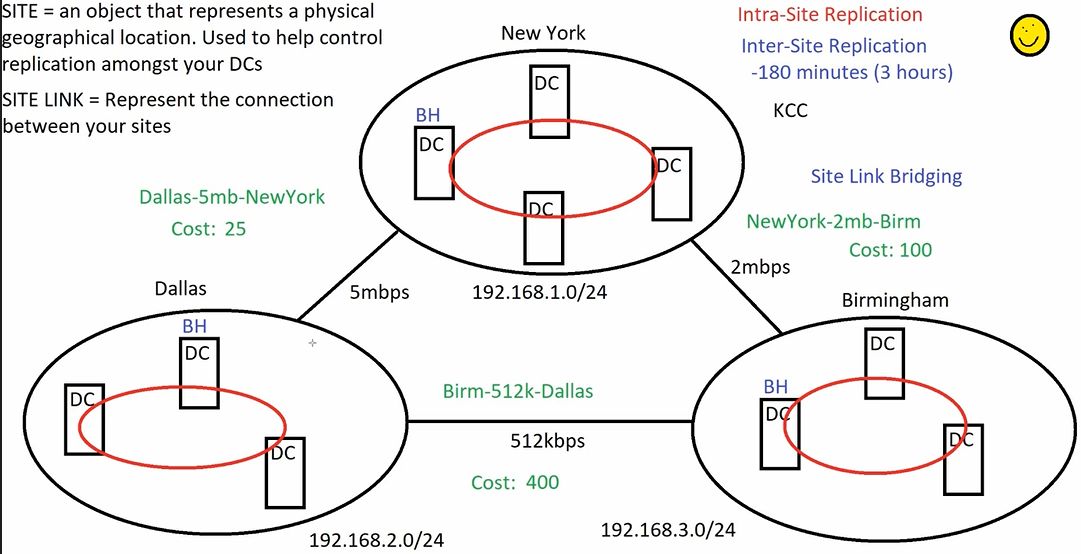
KCC
- Knowledge consistency checker - all D.Cs have it
- Creates a circular ring of trust between D.Cs in close proximity (latency) within the same site (intrasite replication)
- Updates based on D.C. Availbility, checks every 15 minutes
Separation of sites frees up bandwidth.
KCC Creates new rings within each site and appoints one D.C. as a Bridge Head (every 180 minutes) (can be altered) (Inter-Site Replication)
Site Links
- Redundant site links are setup, each have a cost (default 100)
- Adjust cost based on primary and secondary links
- IP Addresses are set such that devices interact with their local D.C. (Subnets)
- Site link bridging can be setup based on a hierarcy (default all on)
- May wish to disable site link bridging where a site has multiple sub-sites
Configured and Managed via AD DS > Sites